
-
Tea Towel - Pomegranate
Vendor:DarzahRegular price $30.00 USDRegular price -
Tea Towel - Olive
Vendor:DarzahRegular price $30.00 USDRegular price -
Tea Towel - Fig
Vendor:DarzahRegular price $30.00 USDRegular price -
Dawa Handwoven Ethiopian Cotton Bath Set | 1 Bath Mat + 1 Bath Towel + 1 Hand Towel
Vendor:SabaharRegular price $169.00 USDRegular price$177.00 USDSale price $169.00 USDSold out -
Jane Handwoven Ethiopian Cotton Kitchen Towel
Vendor:SabaharRegular price $38.00 USDRegular price -
Perfect Host Gift Set | Matching Handwoven Kitchen Towels
Vendor:SabaharRegular price From $48.00 USDRegular price$52.00 USDSale price From $48.00 USDSold out -
Zarima Handwoven Ethiopian Cotton Waffle Hand Towel
Vendor:SabaharRegular price $40.00 USDRegular price -
Kalam Handwoven Ethiopian Cotton Hand Towel
Vendor:SabaharRegular price $38.00 USDRegular price -
Wari Handwoven Ethiopian Cotton Waffle Hand Towel
Vendor:SabaharRegular price $40.00 USDRegular price -
Genalé Handwoven Ethiopian Cotton Hand Towel
Vendor:SabaharRegular price $38.00 USDRegular price -
Roha Handwoven Ethiopian Cotton Kitchen Towel
Vendor:SabaharRegular price $38.00 USDRegular price$0.00 USDSale price $38.00 USD -
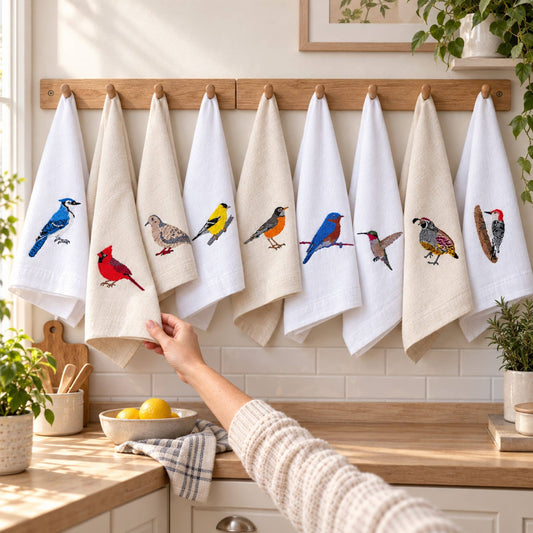
Bird Embroidered Cotton Tea Towels - Handmade Kitchen Gift
Vendor:EcoduniaRegular price $22.00 USDRegular price -
African Wildlife Cotton Tea Towels - Handmade Kitchen Gift
Vendor:EcoduniaRegular price $22.00 USDRegular price -
Tea Towels - Snowflake
Vendor:Maison d’HaitiRegular price $28.00 USDRegular price -
Tea Towels - Lemon Blossom
Vendor:Maison d’HaitiRegular price $28.00 USDRegular price -
Tea Towels - Fork & Knife
Vendor:Maison d’HaitiRegular price $28.00 USDRegular price








Why Buy Fair Trade Kitchen Towels?
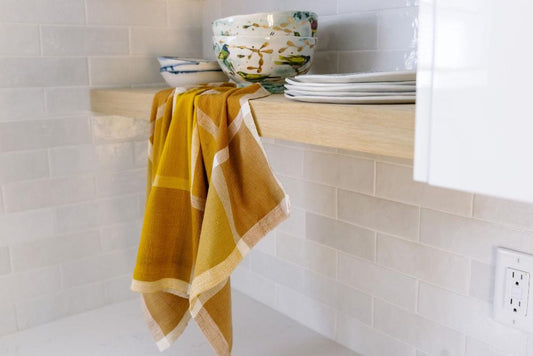
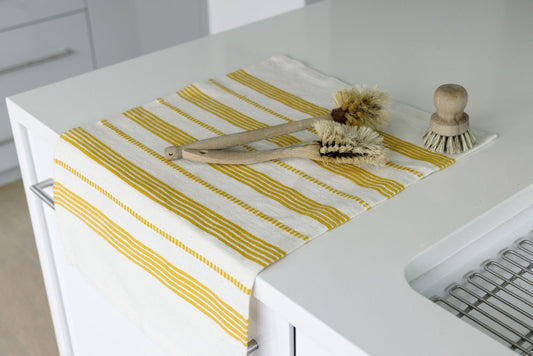
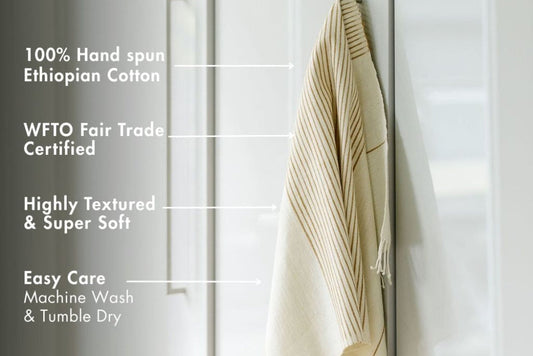
Kitchen towel production involves yarn sourcing, weaving, and finishing — a textile supply chain where labor conditions at the mill and workshop level are central to fair trade verification. Handwoven kitchen towels require skilled loom operation and consistent weaving quality across each towel's length. The functional nature of kitchen towels can obscure the craft labor behind handwoven production, which in conventional markets is often priced against the cheapest available mill-woven alternative.
Fair trade sourcing applies wage and condition standards at the production stage, and for handwoven producers, pricing that reflects actual weaving time per towel rather than mill-production benchmarks. For weaving artisan communities where kitchen textile production is a primary livelihood, fair trade buyer relationships provide the income stability that sustains both the community and the craft.
A kitchen towel is the most-handled textile in most kitchens. Choosing fair trade means the craft behind it is taken seriously, and the production workers who made it were compensated fairly for work that is both skilled and essential.
What is fair trade home and garden decor?
How can I tell if kitchen towels are actually fair trade?
Are the artisans who make these kitchen towels paid fairly?


Verified ethically made
Every product on The Labour Movement meets our standards for Fair Trade production.
Featured certifiers and membership organizations


